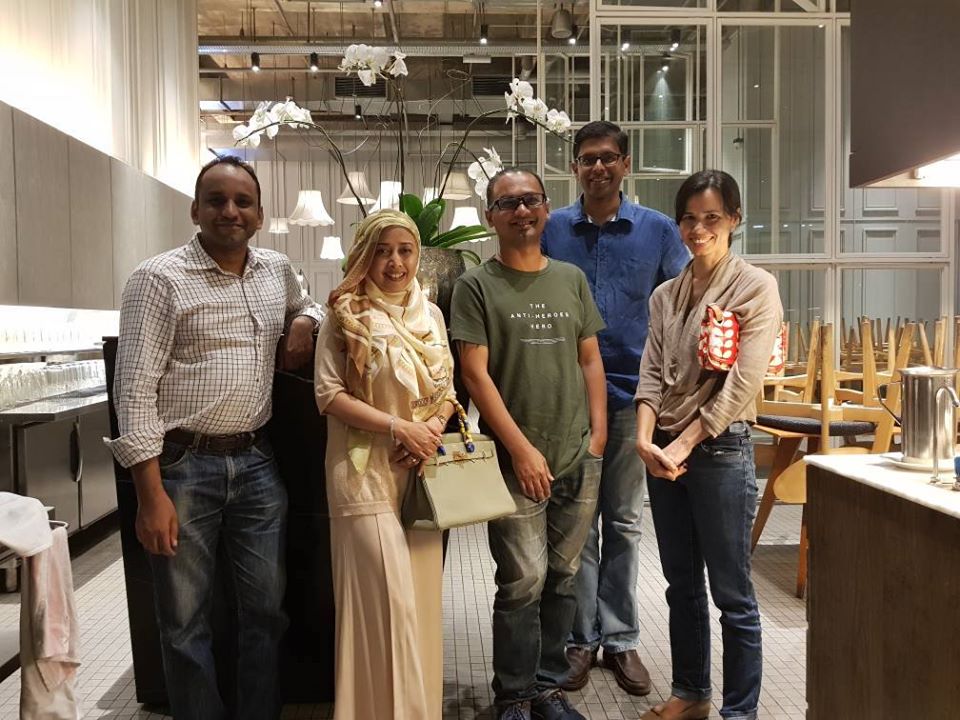
From Left to Right: Assoc. Prof Vairavan Narayanan, Prof Norlisah Ramli, myself, Prof Dharmendra Ganesan and Assoc. Prof. Dr Azlina Ahmad Annuar.
It has been almost 9 years (2011 to be exact) since the day I first walked into the operating theatre of my doctoral supervisor, Prof Dharmendra Ganesan, a pediatric neurosurgeon, who gave me a quick theoretical introduction to neuropathology, brain anatomy, radiological key points and the neurosurgical approach to be employed in his surgery. I remember being so awestricken by what I saw in the operating theatre that day (besides a pulsating physical brain). He was a clinician who had an in depth understanding of the disease, its nature and chronological course. His anatomical knowledge was phenomenal and his surgical finesse were second to none. He knew the anatomical landmarks very well, and resected the delicate brain tissues with extreme care and focus, but relatively at ease. He was my Wilder Penfield (as Penfield was to Brenda Milner – the empress of modern day clinical neuropsychology). Unbeknownst to him, at that moment, I made a personal vow and aspired to be just like him (as a safe clinician and being a great one at it). I realised that the journey would lasts a lifetime.

(Wilder Penfield in 1913 , original photo By United States National Library of Medicine – https://collections.nlm.nih.gov/catalog/nlm:nlmuid-101426096-img, Public Domain, https://commons.wikimedia.org/w/index.php?curid=75916291)
A couple of months into my clinical internship, my other clinical supervisors came onboard. It began with Assoc. Prof. Dr Vairavan Narayanan, a distinguished neuro-oncology, epilepsy and skull base neurosurgeon. I met him for the first time during the usual morning grand rounds. I saw him standing across the on-call room inside the Neuro ICU ward, appearing calm and collected. Something about him gave the aura that he is a warm kindred. He was that all suited up, neat looking, quaint young professor who had just returned from Cambridge. After our initial exchange of pleasantries, inquisitive academic conversation started and the journey began. Over the next 5 years during the course of my doctorate, he started refining and moulding my character both as an academic and a clinician. He was a refreshing fountain of goodwill and limitless knowledge . A tough Guru that he is, his reprimands and rebukes, changed my clinical worldview and continues to guide my conscience in my clinical practise to this day. I learned great amount of humility, empathy and ethics required of a clinician through him while dealing with patients with diverse neurological or neurosurgical disorders. Dr Vairavan was also central in introducing me to the world of neuropsychological neurosurgery, presurgical planning and intraoperative brain mapping. He was the person who kick-started the complex-multidisciplinary awake brain surgery service in University of Malaya back in 2014, which in turn, inspired me to push the boundaries of clinical neuropsychology in Malaysia (alongside my other neuropsychology comrades).
Next to come on board was Professor Dr. Norlisah Ramli, an eminent Malaysian Neuroradiologist. She was a mentor and my “Master Yoda”, who taught me everything that I know and understand about neuroimaging today. Her small physical stature belies her vast insights and expertise in neuradiology, that would command utmost respect and reverence from peers and foes alike. With hundreds of publications and thousands of citations, she is one of the most knowledgeable and well informed clinician scientist that I have come across. Thanks to her guiding nature, my professional view of neuroimaging has evolved and grew over the years. She nurtured and shaped my understanding of advanced imaging modalities including diffusion tensor imaging, spectroscopy and functional MRI (fMRI). Looking back, as a clinical neuropsychologist, I do believe that a good understanding of brain imaging modalities and its interpretation makes a significant difference in how you diagnose, treat and manage your patients safely and responsibly.
Lastly, Prof Mark William Bondi, a world-renowned clinical neuropsychologist and a world authority in the field of neurodegenerative disease and traumatic brain injury. I was introduced to his eminent self by Dr Pollyana Casmar (whom I met during an APA Conference in Hawaii). His calm and humble demeanour with a gentle guiding nature has always had a long lasting impact on me, and guides the way I supervise and train my clinical interns. Personally, I would liken Prof Mark Bondi to an old grand master that one will always revere, knowing that he will always be there to lead and guide you throughout your clinical journey. I remember the day I met him for the first time at the VA Hospital, University of California San Diego. An eminent figure with a very humbling gentle appearance. His expertise in the broad area of clinical neuropsychology, neuroimaging, psychiatry, genetics, neurodegenerative conditions and brain injury continues to inspire and motivate, even years after my doctoral training.
(My two other doctoral advisors and collaborators were Assoc. Prof. Dr Lisa Delano-Wood and Assoc. Prof. Dr. Azlina Ahmad Annuar for whom I have a lot of respect and admiration for. I would write about my journey with them and my Master’s supervisor, Assoc. Prof. Dr Azlina Mohd Kosnin on a separate post).
 Diaries of a Tattooed Neuropsychologist - Journeys into the World of the Human Mind